

The Burden Is Real, but So Is the Path Forward
There’s a quiet crisis happening on the websites of small public entities. Fire protection districts, water and sanitation districts, library districts, metro districts: organizations that often run with a handful of employees and a part-time board are now expected to meet the same digital accessibility standards as a state agency with a full IT department.
The intent behind these laws is good. People with disabilities deserve equal access to public information, and for a fire district, that information can literally be about safety. But anyone who has worked with a small district knows that intent and capacity are two very different things.
I recently worked with a small special district facing exactly this challenge. Their story is a useful example of what these organizations are up against, and what a realistic, defensible approach looks like.
The Rules Are Real, and They Have Teeth
At the federal level, the Department of Justice’s 2024 rule under Title II of the ADA requires state and local governments, including special districts, to make their websites and mobile apps conform to WCAG 2.1 Level AA. This spring, DOJ extended the deadlines by a year: large public entities now have until April 26, 2027, while smaller jurisdictions and special district governments have until April 26, 2028. Notably, DOJ cited resource constraints, staffing limitations, and slower-than-expected technology solutions, including the limits of generative AI for remediation, as reasons for the extension. In other words, even the federal government acknowledged the burden is real. accessiBeConsumer Financial Services Law Monitor
But the extension isn’t a pause. The underlying obligation to provide equal digital access remains in force, and the ADA’s private right of action is independent of federal enforcement deadlines. accessiBe
Here in Colorado, the stakes are even more immediate. State law HB21-1110 already applies, and its enforcement began July 1, 2025, using the same WCAG 2.1 AA standard as the federal rule but with earlier deadlines and explicit state-court damages. Under that law, an inaccessible website can expose a government entity to a $3,500 statutory fine payable to the individual for each violation. And the scope is broad: it covers websites, applications, documents, video, audio, and third-party tools. Colorado HB 21-1110 Website Accessibility Requirements for Government Entities +2
For a district with an annual budget that might not cover a single full-time employee, that exposure is sobering.
The Problem Isn’t Just the Website
When people think about website accessibility, they picture the website itself: menus, color contrast, image descriptions, keyboard navigation. A good web developer can address most of that in a reasonable amount of time.
The harder problem is the content, and specifically the documents.
A small fire district doesn’t write most of what it posts. It receives fire mitigation updates from state agencies. It shares training program materials, safety and educational resources, permit applications, and forms that originate from other organizations. Much of this arrives as PDFs, and many of those PDFs were never built with accessibility in mind: no tags, no reading order, no alt text on images, scanned pages with no real text at all.
The district didn’t create these files, but once the district posts them on its own website, they become the district’s content. The narrow exceptions in the federal rule cover third-party content not posted by or on behalf of the entity, which is not the same as a document someone else wrote that the district chose to publish. Usablenet
The Financial Documents Problem
Then there are the financial documents, which may be the toughest part of the whole puzzle.
Special districts are typically required to post budgets, audits, and financial statements online, often going back several years. These documents are usually prepared by outside CPA firms and are full of complex tables: multi-level headers, merged cells, footnotes, and columns that only make sense visually. Accessible tables require proper header associations so a screen reader can tell a user which row and column a number belongs to. Complex financial tables are some of the hardest content to remediate correctly.
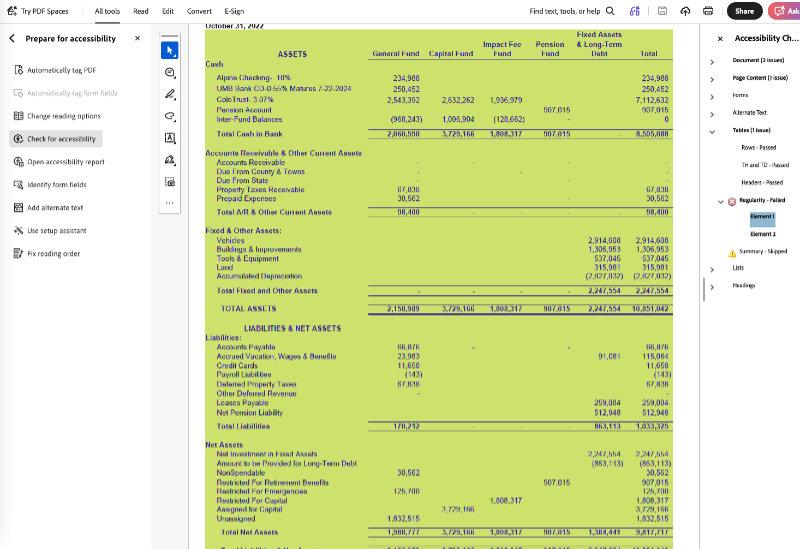
Now imagine the district needs to post five to seven years of these. The original source files, the Excel workbooks that could have been used to build accessible versions, often don’t exist anymore. The district only ever received the final PDF. The CPA who prepared them has retired. In some cases, the CPA has passed away and the firm has closed. There’s no one to ask for the originals.
That leaves two options: manually remediate each complex PDF, or rebuild every table from scratch in HTML or an accessible format. Either way, you’re paying skilled labor by the hour to recreate documents page by page, and across multiple years of audits that cost climbs quickly. For a small district, it can be genuinely out of reach.
The Legal Complexity Is Its Own Burden
On top of the technical work, someone has to understand the rules. What counts as archived content? Which older documents fall under exceptions for pre-existing documents? Does a legally required financial report count as content “in active use”? What does “good faith effort” look like in practice?
These aren’t questions a district administrator should have to answer alone, but hiring an attorney who specializes in accessibility law isn’t cheap either. And the exceptions are narrower than they first appear. As one legal analysis notes, these exceptions are narrow and do not remove the obligation to provide accessible services. Usablenet
So the district is caught between laws it must follow, content it doesn’t control, historical documents it can’t easily fix, and professional help it can barely afford.
A Realistic Strategy: Prove Effort, Fix Forward, Remediate What You Can
Perfection on day one isn’t realistic for most small districts. What is realistic, and what demonstrates a serious commitment, is a documented strategy built around four pieces.
A public accessibility statement. This is more than a boilerplate notice in the footer. It’s a clear mission statement that explains the district’s commitment to accessibility, the standard it’s working toward (WCAG 2.1 AA), what has been done, and what’s still in progress. It’s a living document and a visible record of good-faith effort.
A dedicated accessibility contact. Every district should name a specific person, with an email address and phone number, whom anyone can reach to request an accessible version of a document or information in an alternate format. If a resident can’t read a scanned permit form or a complex audit table, they need a clear, fast path to get that information another way, whether that’s an accessible file, a phone walkthrough, or a plain-language summary. Even while remediation is underway, this ensures no one is shut out.
A process for creating accessible content going forward. This is where the long-term burden actually shrinks. The district adopts standard practices for building documents in Word, Excel, and PDF: proper headings, real text instead of scans, alt text for images, simple table structures, and accessibility checks before anything is published. Staff get basic training and templates. Outside partners, including state agencies, program providers, and especially CPA firms, are asked to deliver accessible files, and native source files like Excel workbooks whenever possible. New contracts can include accessibility requirements. The goal is simple: stop adding to the pile.
A prioritized remediation plan. Not everything can be fixed at once, so the plan focuses first on what matters most: current forms and applications, safety and emergency information, and the most recent required financial documents. Older content is evaluated for whether it can be properly archived, remediated over time, or made available on request. The plan includes timelines, and progress is documented as work is completed.
Together, these pieces tell a clear story: the district understands its obligations, is actively working to meet them, provides alternatives in the meantime, and has a plan to close the gaps.
Why Experienced Help Still Matters
Automated scanners and AI tools can flag many accessibility issues, and they’re useful. But they can’t determine whether a complex financial table reads correctly to a screen reader, whether alt text actually conveys what a wildfire mitigation diagram shows, or how to prioritize a remediation backlog against a limited budget. Those calls take human judgment and experience with how these documents are actually used.
Small districts don’t need to become accessibility experts. They need a partner who can translate the requirements into a practical plan, fix what can be fixed efficiently, build processes that prevent new problems, and document everything along the way.
The Bottom Line
The accessibility burden on small special districts is real. They’re being asked to meet modern standards with limited staff, limited budgets, content they didn’t create, and historical documents that may be impossible to recreate cheaply.
But “we can’t do it all” doesn’t have to mean “we can’t do anything.” A clear accessibility statement, a dedicated contact, better processes going forward, and a realistic remediation plan put a district on solid ground, both for serving its community and for demonstrating the good-faith effort that these laws are ultimately designed to encourage.
This article is for general informational purposes and isn’t legal advice. Districts should consult legal counsel about their specific obligations.
Sources:
Federal ADA Title II rule and deadline extension
Consumer Financial Services Law Monitor, “DOJ Extends Title II ADA Web Accessibility Rule Compliance Deadlines for State and Local Governments” (April 2026). Supports the WCAG 2.1 AA requirement, the new 2027/2028 deadlines, and DOJ’s stated reasons for the extension.
https://www.consumerfinancialserviceslawmonitor.com/2026/04/doj-extends-title-ii-ada-web-accessibility-rule-compliance-deadlines-for-state-and-local-governments/
accessiBe, “ADA Title II deadline extended: what this means for state and local government” (2026). Supports the point that the obligation remains in force and that private lawsuits are independent of federal deadlines.
https://accessibe.com/accessibility-platform/reports/title-ii-government-agencies/title-ii-deadline-extension
UsableNet, “Title II Compliance Timeline: Key Dates and Deadlines” (April 2026). Supports the description of the rule’s limited exceptions, including third-party content and archived content, and that those exceptions are narrow.
https://blog.usablenet.com/title-ii-compliance-deadline-2026
Colorado HB21-1110
Accessibility.Works, “Colorado HB 21-1110 Website Accessibility Requirements for Government Entities” (2026). Supports the July 1, 2025 enforcement date and the comparison to the federal rule.
https://www.accessibility.works/colorado-hb-21-1110/
Colorado Governor’s Office of Information Technology, “FAQ: HB21-1110 Colorado Laws For Persons With Disabilities.” Supports the $3,500 per-violation statutory fine and the broad scope covering documents, video, audio, and third-party tools.
https://oit.colorado.gov/hb21-1110-faq
Further reading
Colorado Virtual Library, “New Federal Accessibility Rules” (quotes the Federal Register language on the extended dates).
https://www.coloradovirtuallibrary.org/technology/websites/new-federal-accessibility-rules/
Duane Morris LLP, “DOJ Extends ADA Title II Digital Accessibility Deadlines by One Year” (notes that special districts such as fire protection authorities are covered).
https://www.duanemorris.com/alerts/doj_extends_ada_title_ii_digital_accessibility_deadlines_one_year_0426.html
Seyfarth Shaw, ADA Title III blog, “DOJ Extends ADA Title II Website Accessibility Deadlines for Governmental Entities” (April 2026).
https://www.adatitleiii.com/2026/04/doj-extends-ada-title-ii-website-accessibility-deadlines-for-governmental-entities-but-litigation-and-compliance-risks-remain/