

SEO, AEO, and GEO: Why Your Website Needs to Compete on All Three Fronts
Search has changed more in the past three years than in the previous decade. Ranking on page one is no longer the whole game.
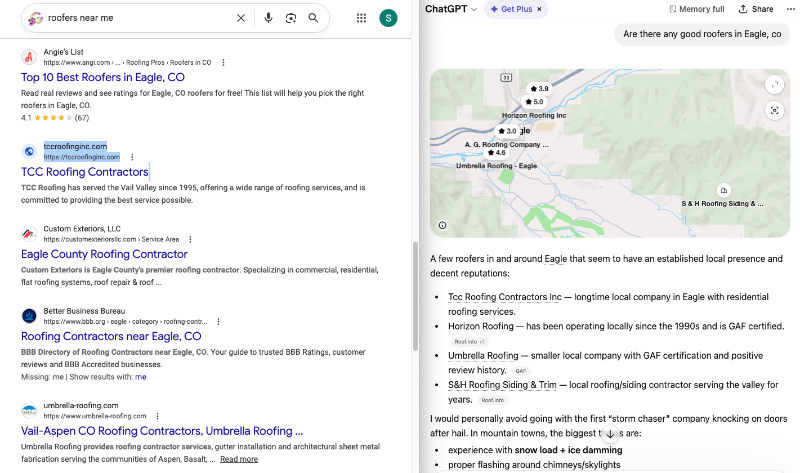
Not long ago, the conversation about online visibility was relatively simple. You hired someone to help your website rank in Google, watched your position on a list of blue links, and measured success by how much traffic came through the door. That model still has merit. But it no longer tells the whole story.
The way people find businesses, services, and answers has fractured across multiple surfaces. A growing share of searches end without a single click because Google answers the question directly at the top of the page. A separate and rapidly expanding audience is bypassing Google entirely, asking ChatGPT, Perplexity, or Google’s own AI tools to recommend a contractor, explain a process, or compare their options. Each of those surfaces operates on different rules.
Three disciplines now determine where and how your business appears online: Search Engine Optimization, Answer Engine Optimization, and Generative Engine Optimization. Understanding the difference between them is the first step toward not being invisible to the customers who are already looking for you.
Three Disciplines, Three Different Jobs
SEO, AEO, and GEO are not competing strategies. They are complementary layers of a complete visibility approach. Each one targets a different surface, a different user behavior, and requires a different kind of technical and content work to get right.
SEO: The Foundation That Still Matters
Search Engine Optimization is the oldest and most established of the three. Its core purpose has not changed: earn a place in Google’s organic results for the searches your prospective customers are running. What has changed is the technical bar required to compete.
Google’s ranking signals have grown considerably more sophisticated. Page speed and Core Web Vitals now directly affect ranking. Mobile performance is not a bonus consideration but a primary one. The quality, depth, and structure of your content is evaluated against the concept of E-E-A-T: Experience, Expertise, Authoritativeness, and Trust. Sites that demonstrate genuine subject matter authority through well-sourced, well-structured content consistently outperform those producing thin or keyword-stuffed pages.
For most businesses, the foundation elements are straightforward to inventory but time-consuming to implement correctly: proper heading structure, unique and accurate meta descriptions, a clean XML sitemap, a logical internal linking architecture, and content that answers the specific questions your audience is searching for. Getting these right is not glamorous work, but skipping them creates a ceiling on everything else you try to do.
A technically sound SEO foundation is a prerequisite for both AEO and GEO performance. Businesses that skip the fundamentals and jump to the newer disciplines tend to see limited results from either.
AEO: Competing for the Answer, Not Just the Ranking
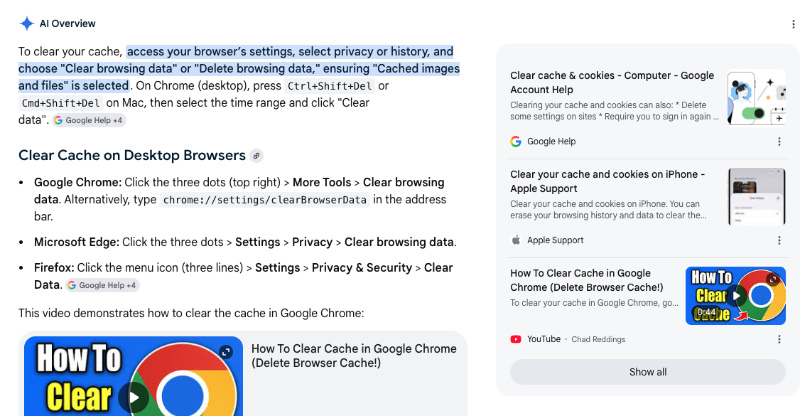
Answer Engine Optimization addresses a specific and increasingly common search behavior: the user asks a question, Google answers it at the top of the page, and the user gets what they need without visiting any website. From the user’s perspective, this is a seamless experience. From a business’s perspective, it represents either a significant opportunity or a significant loss of traffic, depending on whether their content is the one Google chose to display.
Featured snippets appear above all paid and organic results. They can take the form of a paragraph, a numbered list, a table, or a short definition. Alongside them, People Also Ask boxes surface related questions and their answers in expandable accordion panels. For voice search, where Google or Siri reads a single answer aloud, the source of that answer is almost always a featured snippet.
The technical work behind AEO centers on structured data, also referred to as schema markup. This is code added to a website that explicitly tells search engines what the content represents: a local business, a frequently asked question, a step-by-step process, a product with a price. Without it, Google has to infer these things. With it, Google knows with certainty, and the likelihood of appearing in enriched search formats increases substantially.
Content structure also plays a direct role. Pages that phrase a heading as a question and answer it concisely in the following paragraph, in 40 to 60 words, are strong candidates for featured snippet selection. This is not accidental. It requires deliberate content architecture, and it requires someone who understands both the technical markup requirements and the editorial approach that Google’s systems respond to.
How the Three Disciplines Compare
| Factor | SEO | AEO | GEO |
|---|---|---|---|
| Primary target | Google / Bing rankings | Featured snippets, PAA, voice | ChatGPT, Perplexity, AI Overviews |
| Core signal | Authority, relevance, speed | Schema markup, Q&A structure | Content depth, E-E-A-T, credibility |
| Content format | Keyword-targeted pages | Concise Q&A blocks | Authoritative long-form guides |
| Time to results | Weeks to months | Weeks to months | Months (model training cycles) |
| Technical complexity | Medium to high | Medium (schema required) | Low-medium (content-led) |
| Biggest mistake | Thin or duplicate content | Missing schema markup | Promotional writing tone |
| Measurement | Rankings, organic traffic | Snippet capture, CTR | AI brand mentions, referral traffic |
GEO: The Newest Frontier, and the Most Misunderstood
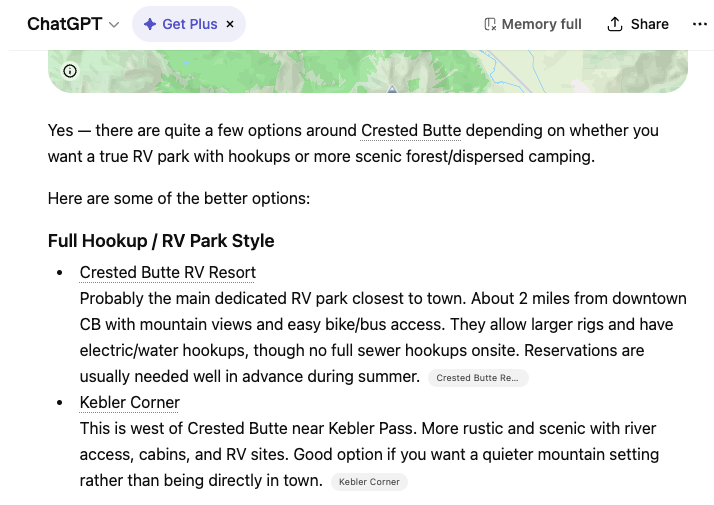
Generative Engine Optimization is the newest of the three disciplines and the one most businesses are not yet thinking about. It addresses the growing behavior of users who bypass search engines entirely and ask an AI assistant to give them a recommendation, summarize their options, or explain something they need to understand before making a decision.
When someone asks ChatGPT which HVAC company services Vail Valley, or asks Perplexity to explain the difference between a boiler and a forced-air system, the AI tool assembles its answer from sources it has learned to trust. GEO is the work of becoming one of those trusted sources.
“The brands that AI tools cite today are building an authority position that will be very difficult for late-moving competitors to replicate. This is the same dynamic that played out in early SEO, and the window for early-mover advantage is narrowing.”
What AI tools respond to is meaningfully different from what traditional search engines reward. Promotional language is filtered out in favor of specific, factual, and genuinely helpful content. Authorship and credentials matter because AI systems evaluate source credibility. Content that cites external evidence, links to primary sources, and demonstrates subject matter depth is significantly more likely to be pulled into an AI-generated answer than content that reads like a brochure.
There is also a technical dimension that many businesses overlook entirely. AI crawlers, the automated systems that read websites on behalf of tools like ChatGPT and Perplexity, can be inadvertently blocked by a website’s configuration. A business can have exceptional content and still be completely invisible to GEO if the right access settings are not in place. This is a fixable problem, but it requires someone who knows to look for it.
Where Each Discipline Touches Your Customer’s Journey
One useful way to think about SEO, AEO, and GEO is to map them against the stages a prospective customer moves through before contacting a business.
The takeaway is that no single discipline owns the customer journey. Businesses that invest only in traditional SEO are invisible at the awareness and research stages where AI tools and answer boxes now dominate. Businesses that focus only on GEO without a solid SEO foundation tend to lack the domain authority that AI tools use as a credibility signal in the first place.
The Compounding Effect of Getting All Three Right
The most significant characteristic of these disciplines is that they compound. Early investment builds authority that makes subsequent efforts easier and more effective. The bar chart below illustrates the relative long-term impact of investing in one, two, or all three disciplines based on observed patterns in how search visibility scales over time.
Note: Figures represent relative visibility potential based on industry benchmarks and are intended as directional guidance, not precise projections. Actual results vary by industry, competition, and execution quality.
What Doing This Well Actually Requires
It is worth being direct about the scope of work involved, because this is an area where the gap between surface-level effort and genuine expertise produces very different outcomes.
Effective SEO requires technical auditing, crawl analysis, Core Web Vitals optimization, structured site architecture, and an ongoing content strategy tied to real keyword and competitive research. It is not a one-time project.
AEO adds a layer of schema implementation that most general web developers are not deeply familiar with. FAQPage, LocalBusiness, Article, HowTo, and Review schema each have specific requirements, and incorrect implementation can be worse than no implementation at all. Google’s Rich Results Test and Schema.org validation are part of the QA process.
GEO requires both a content strategy shift and a technical audit of how AI crawlers interact with the site. It also requires ongoing monitoring of how the business appears in AI-generated answers, an emerging practice that requires specific tools and a methodical approach to tracking and improvement.
Running performance audits, page speed analysis, schema validation, AI visibility checks, and consolidated reporting across all three disciplines is a sustained engagement, not a checkbox. It requires someone who understands the full picture and can translate technical findings into recommendations that move the needle for the business.
Most businesses do not need to understand the technical details of schema implementation or robots.txt configuration. What they do need is a trusted partner who handles that layer competently, reports back in plain language, and can demonstrate measurable progress over time.
Where to Start
For most businesses, the starting point is an honest assessment of where they currently stand across all three disciplines. That means auditing what schema markup exists and whether it is valid, checking which queries return featured snippets and whether the business appears in any of them, and running a baseline test of how the business is described when relevant questions are asked in AI tools.
From that baseline, it becomes much clearer where the highest-impact improvements are and in what order they should be prioritized. Some businesses will find quick wins in AEO because their content is already strong but lacks schema markup. Others will find that their site is inadvertently blocking AI crawlers and that a single configuration change opens up significant GEO visibility. Others still will need to address foundational SEO issues before the more advanced work can take hold.
The common thread is that none of this is guesswork once you have real data in front of you. And the businesses that invest in getting that picture clearly are in a meaningfully better position than those that assume things are fine because traffic has not noticeably dropped yet.
Search has changed. The question is whether your visibility strategy has kept up.
Not sure where your site stands?
We audit businesses across all three disciplines and report back in plain language. No jargon, no obligation. Just a clear picture of where you are and what would make the biggest difference.
Get in touch- SparkToro / Datos, “How Much of Google’s Search Traffic is Left for Anyone But Google?” (2024) — sparktoro.com
- Reuters, “ChatGPT sets record for fastest-growing user base” (2023) — reuters.com
- Salesforce, “State of the Connected Customer” (2024) — salesforce.com
- Google, “How Google Search works: Understanding featured snippets” — developers.google.com
- Google, “Introduction to structured data markup” — developers.google.com
- Google, “Search Quality Evaluator Guidelines (E-E-A-T)” — guidelines.raterhub.com
- Perplexity AI, “How Perplexity works” — perplexity.ai
- Schema.org, Structured Data Vocabulary Reference — schema.org
- Brightedge, “Voice Search and AI Search Optimization” (2024) — brightedge.com
- Search Engine Journal, “Zero-Click Searches: What They Are and How to Optimize for Them” — searchenginejournal.com